
£600,000 programme enabled £7 million of affordable lending to 8,300 people, saving each an average of £1,200 in interest compared with high-cost alternatives.
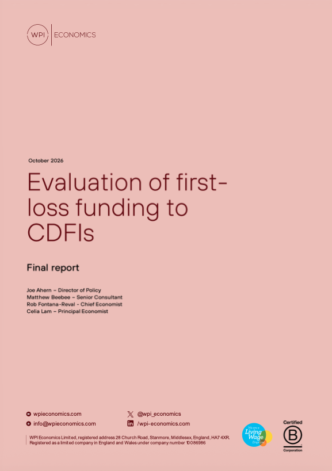 Women, lone parents, people on low incomes, social housing tenants, people living with a disability and benefit recipients who borrowed from community lenders (CDFIs) saved significant sums of interest according to an independent impact analysis by WPI Economics, published today. Funding the responsible lenders delivered strong value for money of up to £18 for every £1 invested, according to a Cost-Benefit Analysis.
A pilot programme delivered by three Responsible Finance members (Fair Finance, Fair for You and Salad Money) enabled them to grow their lending to financially-vulnerable and underserved people in London. Beyond saving money by borrowing from CDFIs compared with higher-cost options, customers reported improvements in their mental and physical health, financial confidence, ability to manage debt, productivity and stability; and reductions in financial stress.
Despite the perceived high-risk nature of lending to some of these groups, the loans were found to have low arrears, defaults and write-off rates.
These vital impacts – and measurable economic and social benefits – come when the number of “financially vulnerable” adults has increased to more than 20.3 million. The evaluation shows the potential of ‘first-loss’ funding to become a strong long-term tool for expanding access to affordable credit. The programme supported financial inclusion by unlocking capital, expanding affordable and responsible lending and delivering strong value for money.
“It takes a weight off your shoulders really… I didn’t want to take out payday loans with high rates.” A CDFI customer.
CDFIs and the pilot ‘first-loss’ funding programme
Community development finance institutions (CDFIs, our members) are locally-rooted social enterprises that provide credit to individuals, businesses and social enterprises that are often underserved by mainstream lenders. They play an important role in improving access to affordable finance. In 2025, personal-lending CDFIs lent £129m to140,000 UK households. By helping to fill gaps in the credit market, CDFIs reduce the likelihood that individuals turn to illegal or high-cost lenders. But CDFIs are only reaching a small proportion of the millions of financially underserved and vulnerable people in the UK.
CDFIs need access to external funding and investment to grow their lending. First-loss funding is one way to help unlock this. It is designed to help CDFIs to reduce their reliance on high capital costs as well as expand their lending: it provides other investors with protection against a proportion of ‘first-losses’ by absorbing an agreed proportion of early credit losses.
City Bridge Foundation, London’s largest independent charitable funder, worked with Responsible Finance to pilot £600,000 first-loss funding in November 2023 to three CDFIs – Fair Finance, Fair for You and Salad Money – to service underserved consumers in London. The pilot’s purpose was to assess whether first-loss funding could play a catalytic role in leveraging external capital to permanently increase CDFIs’ capacity to provide more customers with affordable credit.
Responsible Finance commissioned WPI Economics to evaluate the impact and value for money of the first-loss funding grant from City Bridge Foundation, covering November 2023 – September 2025.
The independent evaluation found:
- First-loss funding can unlock significantly greater investment and affordable lending
The £600,000 City Bridge Foundation grant helped the three participating CDFIs accelerate the deployment of £2.4 million of senior capital, enabling almost £7 million of affordable lending to more than 8,300 financially underserved people in less than two years. More than half of these loans were to new customers. Customers served by CDFIs typically have limited access to mainstream credit, often as a result of poor credit histories or financial circumstances that do not meet mainstream lenders’ affordability and risk criteria. The CDFI loans had a weighted average interest rate of 60% APR, substantially lower-cost than the high-cost credit options typically available to these customers which have an average APR of around 1,250%, resulting in interest savings for CDFI borrowers.
“Securing the loan provided financial relief and stability, allowing me to avoid high-interest payday loans and manage my finances better.” A CDFI customer.
- The model delivered strong value for money.
The analysis indicates that first-loss funding delivers strong value for money, evaluation estimates that every £1 of first-loss funding generated approximately £2–£3 of monetisable benefits for borrowers, rising when wider welfare benefits (£3-£4) and the accelerated deployment of senior capital (£14-£18) are taken into account:
“The minimum Benefit-Cost Ratio (BCR) is around 2 to 3 from interest savings to customers alone…When the impacts of the deployment of accelerated or additional capital are considered as part of the CBA , the pilot is found to deliver especially strong value for money. Under this scenario, the estimated BCR is approximately 14, or 18 when welfare gains are included.
“These core numbers do not account for wider societal benefits, including improved subjective wellbeing and productivity gains through reduced absenteeism and presenteeism. Taken together, these results demonstrate that first-loss funding generates substantial value both for individual customers and for society as a whole.” WPI Economics.
- Serving financially underserved customers does not mean poor lending performance.
Loans in arrears (7.3% of total loans) and defaults (3.3%) across the pilot have remained low, relative to the default rates of credit card loans, despite the participating CDFIs lending to customers who are often perceived as higher risk.
- The evidence supports scaling the model.
The evaluation concludes that larger and longer-term first-loss funding could help more underserved customers to access affordable credit, give investors greater confidence, and attract more private and social investment into affordable credit; being part of a wider toolkit including guarantees and capacity building funding.
What next?
Some of this investment and lending could have happened more slowly without the first-loss funding but the grant acted as a catalyst – enabling capital to be deployed sooner, recycled into further lending and reach more people at a time when household finances were under intense pressure.
The opportunity now is to take this model further. First-loss funding should form part of a wider package of support for affordable credit, alongside guarantees, investment, better data and capacity building. Philanthropic funders in particular can play a catalytic role: using relatively modest amounts of grant funding to take risk that others cannot, crowd in much larger amounts of investment and help affordable lenders reach substantially more people.
Tim Wilson, Associate Director of Social Investment and Social Enterprise at City Bridge Foundation, said:
“City Bridge Foundation welcomes this report and hopes it will encourage more organisations to recognise the value of first-loss funding in strengthening the community finance sector. By helping lenders expand access to fair and affordable credit, this approach can provide safe alternatives for people who might otherwise be excluded from mainstream financial services.”
Read the full evaluation:
