
Community Development Finance Institutions that lend to small businesses have scaled up over the past 18 months and doubled their lending. Investment through the British Business Bank and capacity building funding from JPMorganChase and others enabled this growth. It has started a transformation to make this high impact lending mainstream.
Community Development Finance Institutions (CDFIs) turn a no into a yes for small, viable but overlooked businesses. Because their lending is focused on underserved and underrepresented businesses, it creates jobs, growth and positive impact where it is most needed. CDFIs also do incredible work to open opportunities for other parts of society: microbusinesses, social enterprises and individuals.
Small businesses can struggle to access the funding they need for growth or resilience due to their track record and credit score, lack of adequate security, or because they are seeking small sums. In addition to challenges around accessing finance, we’re now seeing a parallel issue: alternative lenders providing easy access to inappropriate products – too high cost and short term for what many businesses need. The type of relationship-based, story-based lending that CDFIs uniquely provide can get to a yes and provide good customer outcomes in both cases.
The role of CDFIs has been recognised as important for the economy and the public and private sectors are both backing the sector to scale: the government established new large-scale long-term funding into the sector through the British Business Bank’s Community ENABLE Funding programme (CEF); and JPMorganChase committed £4m to Responsible Finance alongside CEF for CDFIs to develop their capacity to take on and deploy this new funding. Banks are now convening through the Community Finance Partnership Task Force to explore how they can support the growth of CDFIs so more small businesses can grow and succeed, become active banking customers and contribute higher levels to the economy.
We’re at the foothills of CDFI growth, the key drivers being:
- Capital and investment to lend
- Awareness and demand
- Organisational and operational capacity
All three are interconnected – to take on increased demand, CDFIs must have the capital to lend and ability to process more loans; to be investment ready and absorb capital they need to be operationally robust, and so on.
18 months into delivering the two-year, £4m JPMorganChase grant-funded capacity building programme, we want to share what we’ve done and what we’ve learned.
Why we focused on capacity
There are around 15 CDFIs eligible for the British Business Bank (BBB) CEF scheme. There is a huge range in size from teams of seven people originating £1m each year, to larger teams of over 30 originating £15m a year to established small businesses.
CDFI organisation stats
- Organisational size: 3-33 employees
- Management team size: 1-11 people
- % of team with SME lending focus: 33%-61%
- Number of businesses supported per year: 14-202
- New lending per year: £650k-£15m
Over the past few years, these CDFIs originated approximately £50m-£80m each year to established small businesses, so deploying an additional £150m from CEF over two years on top of their existing funding wouldn’t be possible with their existing resource base.
CDFIs have a 25-year track record in the UK, and have cut their cloth to be operationally sustainable while running a high touch model that makes an impact. The interest and fees CDFIs charge is just enough to be sustainable; reserves are hard earned and managed prudently; revenue grant-funding has been rare for business-lending CDFIs. This means that CDFIs will not invest their reserves aggressively for growth – hiring, investing into new tech – because their historic experience is that funding is unpredictable and they need to ensure they are around for the long-term to support their communities. Unlike the commercial sector, CDFIs cannot offer high returns to investors willing to invest into growth. All of this underlines why CDFIs have grown slowly, so for a step change in lending growth and impact we needed a step change in investment into their infrastructure.
But it’s not just about building the rails for growth. Building organisational capacity within CDFIs de-risks private investment by creating more robust organisations, more specialist roles, more consistent data, functions and processes.
The goal of this programme was to build the foundations for growth and enable the 15 or so CDFIs to get on a relatively level playing field in terms of their scalability. For the smaller CDFIs this meant directly enabling lending volumes that wouldn’t have been possible through hiring staff; for larger CDFIs this meant accelerating investment into innovation that might otherwise have been deprioritised by boards as non-essential. The KPIs we’re measuring our success by are impact lending and efficiency: essentially, how the sector can make disproportionately more impact with its resources.
Of the £4m grant we were very fortunate to secure, approximately two-thirds was reserved for direct on-grants to CDFIs. The remainder was for Responsible Finance to deploy across areas such as central technology, leadership development and marketing for CDFIs.
Role of direct grants to CDFIs
The largest proportion of the programme was direct grants to CDFIs since they did not have alternative funds to invest into their growth infrastructure.
Breakdown of direct CDFI grant uses
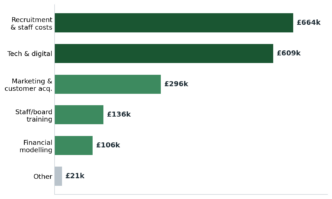
Most of the direct grants (70%) were for staffing and systems upgrades. This has clearly materialised into increased lending (more on that later).
It would have taken years to add these roles and make these back-office improvements organically without the grant. As one CDFI Investment Director said, “The grant let us bring forward plans from our five-year strategy — a Marketing Manager, a CRM and a new back-office system — and to automate parts of our loan process and reporting, cutting manual work and helping us process 15% more loans per employee.”
To give a practical example, one CDFI used its £170k grant for:
- Five new lending staff (covering partial costs).
- Tech work including creating a customer portal for loan applications, a pre-assessment system, workflow automation and integrating digital document management – all together streamlining the lending journey and turnaround times and reducing manual processing to increase capacity to serve more businesses.
- Bring on a fractional CFO to work with them on building a multi-year financial model, modelling their growth and scenario planning.
- Underwriting training for multiple roles including loan officers, underwriters and the investment committee to improve knowledge across the business
- Direct marketing to local SMEs.
The grants were distributed via a competitive application process and an independent Grant Committee. The application and review process brought rigour and (hopefully) helpful challenge to the CDFIs as they plotted their journeys. It also allowed Responsible Finance a greater insight into the business models and operations of our members, and how we could drive change centrally.
We worked with CDFIs to establish SMART KPIs at the outset to ensure funding was directed towards activities that would deliver measurable differences to CDFIs and the sector. Whilst we generally avoided double funding and tried to be strategic with the limited funds, we also recognised CDFIs’ need for flexibility.
Many CDFIs were not comfortable with taking on one-off grants, after years of striving to make their organisations sustainable. What if this level of investment does not continue into the sector and they are stuck with a higher cost base? In their applications CDFIs had to demonstrate the sustainability of their investments, showing how increased lending income could pay for roles over the long term. The grant helped pay for upfront tech costs, and many CDFIs co-funded parts of their transformation budgets, making the drop off after the grant finishes smoother.
Has it worked?
We are drawing data from three early adopter CDFIs: Let’s Do Business Finance (in Hastings), First Enterprise (in Nottingham) and CWRT (in Coventry). CWRT and Let’s Do Business were also among the smaller CDFIs in the business lending cohort.
Some high level snapshots:
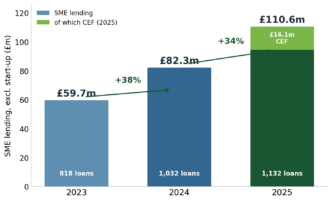
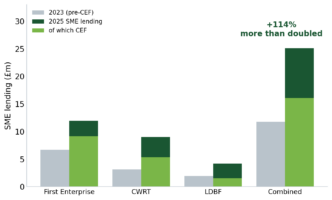
• Each of these CDFIs roughly doubled their lending within two years while maintaining consistent lending levels to underserved businesses, such as those led by women and ethnic minority entrepreneurs, and businesses in deprived areas.
• These three CDFIs accounted for over 50% of the overall business lending sector’s growth last year.
• In 2024 these three CDFIs accounted for 15% of CDFI business lending. This past year, they accounted for a quarter.
These CDFIs were able to take on CEF and lend it impactfully and sustainably because of the grant. As one CDFI CEO said: “Our progress relied on access to both flexible funding (CEF) and grant (JPMorganChase) support — we wouldn’t have achieved this level of growth without both working together.” This level of growth alongside CEF, impact and safe lending would not have been possible without the grant. The grant has built the infrastructure – people, skills, risk management, system abilities – that is enabling growth in lending to a lot more incredible small businesses around the country.
Overall CDFI SME lending 2023-2025
CEF CDFI lending growth 2023-2025
As with any rapid scaling there have been challenges. Keeping up with the pace of demand, whilst expanding underwriting capabilities and resources; especially in the light of the rise in high interest loan-stacking in need of refinancing. The flexibility of the grant to pivot to support CDFIs’ greatest needs, and the collaborative approach between CDFIs, Responsible Finance, BBB and JPMorganChase has meant we can work through these challenges together.
Three key learnings
1) It takes capacity to build capacity
The grants have supported 51 roles at 11 CDFIs over the last year: lending managers, marketing managers, underwriters, compliance officers, finance officers. CDFIs are bringing more specialisation into their organisations. Instead of one individual (usually the CEO) doing multiple jobs (strategy, finance, underwriting, marketing, fundraising, team management), CDFIs are now building out their teams and can manage more complexity. This not only increases the capacity to lend, it helps CDFIs move faster and innovate, because there isn’t a single key person bottleneck.
In addition to getting the right roles in, both CDFIs and Responsible Finance have used the grant to increase the capacity and capability of their governance, finance and compliance functions. For small organisations increasing lending rapidly, these functions are core to growing sustainably. For example, we have funded 10 colleagues from the sector to complete their Certificate in Commercial Lending, and a further 30 colleagues to complete additional training in Underwriting and Credit Assessment.
We have also invested into leadership coaching for CDFI CEOs. CDFIs have used over 448 hours of leadership support, helping CEOs to make space, delegate and prioritise.
2) “We went from 1985 to 2005 in the last two years. Now we need to go from 2005 to the future in the next two”
That is one deputy CEO describing their CDFI’s tech journey. Some of the sector’s biggest challenges have been whether tech will erode what is special and most effective about CDFIs: the human element. There have been conversations about not wanting to become online-only lenders. What customers value most from CDFIs is their support, understanding and personalised touch. The sector’s focus so far has been on automation that can maximise this.
CDFIs have:
- Upgraded to more sophisticated central business software (e.g. accounting and HR) and integrated this with loan management systems to create staff capacity.
- Developed loan management systems to streamline income and expenditure assessments, aligning with the FCA’s Consumer Duty and strengthening the compliance function.
- Set up APIs to integrate data (e.g. credit reference data, Companies House, Open Banking), to do quicker and more thorough eligibility checks on customers. This will improve the customer journey and enable the CDFI to handle more enquiries.
- Responsible Finance built an API between a CDFI loan management system and the British Business Bank to automate reporting, saving CDFIs significant time and improving reporting accuracy.
- Responsible Finance developed a central system of geographic, market and SME data for CDFIs to better target underserved post codes and entrepreneurs, reaching SMEs earlier in their funding journey.
Each CDFI grant application included an element of technological investment, and this first year has led to better use of Open Banking and credit reference data, enabling more CDFIs’ systems to create a smoother journey. Early investments are being made to automate routine manual processes, maximising human time to provide human support to businesses.
The most exciting prospect is that CDFIs now have the opportunity to lead the way on ethical AI and technology. They have always been best-in-class on customer service and lending impact outcomes. Now combined with the tools, resources and confidence on tech, we will start seeing CDFIs develop leading-edge innovation that enables more businesses to get the right support at the right time and more lives improved as a result.
3) Mindset for growth and change
The positive legacy of the history of the business lending CDFI sector is that it created scrappy, lean and sustainable organisations with prudent leaders, who deeply believe in their mission. The reality is that the journey to where we are was gruelling: stop-start funding, government reports diminishing the role CDFIs could play, and (like our customers) repeated ‘no’s from funders. To lead through these times inevitably creates a scarcity mindset, and naturally some scepticism about how long these newfound ‘good times’ will last. As one CDFI CEO told me, “we put up our own barriers to growth”.
To continue the good times we have to deliver and show we can scale to meet the level of need we know businesses have. Therefore, a big focus for the past year has been on mindset, sharing learning and collaboration. We have taken two cohorts of CDFIs to the US, where the sector is further in its growth journey; CDFIs have partnered with BBB NEDs to exchange learning, and several CDFIs are receiving bespoke support from JPMorganChase executives on governance and tech. These initiatives give CDFI leaders – and the younger rising stars in each organisation – the confidence to start thinking big and planning for longer-term growth and impact.
To plan with abundance and ambition though we need continued and long-term investment into the capability and infrastructure of the sector. The goal is to be sustainable and not grant-dependent in the long-term, but like any other business we need external investment during periods of growth and for innovation. Look at commercial lenders and you will see millions invested into their technology and talent. Partnership and funding from our bank partners drives growth, strengthens risk management and ultimately means more underserved entrepreneurs can thrive and create value for the economy that otherwise would not be possible.
Building foundations – what’s next?
Next year, Phase 2 of CEF aims to bring in private sector funding for CDFIs to on-lend. How will CDFIs lend the next £500 million? As a sector, we’ve started to build the foundations. To lend the next £500m, CDFIs need:
- People and skills fit for the future: hiring and training lending officers; recruiting and strengthening boards.
- Technology: creating processes that maximise human time to work with businesses converting more nos to yeses, reducing drop offs and providing an outstanding customer journey that builds SMEs’ financial capability.
- Data: empowering CDFIs with data on their customers, the market and their portfolios; telling our impact story even better; and attracting more investment through high quality and consistent data.
- Awareness: reaching small businesses sooner. Ultimately, we’d like every CDFI to be a local (and beloved) household name.
Capacity building funding works. It builds the rails for long term sustainable growth, de-risks capital investment, and enables CDFIs to stay laser focused on impact. It accelerates what would have likely taken a decade of careful reinvesting, so that CDFIs can be cutting edge.
We are seeking a further tranche of grant funding from JPMorganChase and are working with UK banks on the Task Force to unlock additional high-impact support for the sector, because the scale of need and opportunity is greater than any one funder can meet alone.
We are grateful to our partners at JPMorganChase for investing into capacity building, and to Lloyds Bank and BNY who are also funding this work. Most of all we are grateful and in awe of the CDFIs who have been doing the hard work on the ground. We know it has not always been easy and we appreciate them always taking the time to share learnings and collaborate for the greater mission of providing opportunity to more small businesses. Onwards and upwards!